Accra, the capital of Ghana in West Africa is near the equator, and I did not expect to find pine trees here, did not bother looking for them, not even in the Botanical Garden on campus, but of course you never know. They probably would not survive among the lush vegetation, though. Most pines need harsh circumstances to have some benefit of their sturdiness. Or perhaps that is a myth I have accepted without examination.
The theme of the conference that brought me here is “The Stories We Tell. Myths, Myth Making & Performance”, described on the front-page of the IFTR website, and later moved to ‘past conferences’. The main reason I keep returning to these conferences (this time with support from The Finnish Cultural Foundation) for theatre scholars – IFTR stands for the International Federation for Theatre Research – is the Performance-as-Research Working Group. As always we had some great sessions of sharing practice, collective creation and critical conversations. Documenting only my own contribution is in some sense pointless, because everything happens as a group effort and becomes something else than planned. I have nevertheless done that, perhaps partly to remember and share the material that was dissolved into the ‘sea’ of group experimentation. The video material related to my contribution was on the RC page Pine for PAR 2023 already before the conference. During the session I gathered some stories related to pines from the participants and they, or the re-edited version of the video with them, will be uploaded on that page in due time.
Today I was finding my way to the foot bridge over the highway near the hotel in order to reach Accra Mall, which I visited the day I arrived here and later called my “Africa experience”, (the walk there, not the mall), and thought about the absurdity of it all. Or rather saw it as a condensation of the discrepancy between different worlds today. During the conference week my main struggle was with too much air-conditioning in old buses taking us from the hotel to the campus and back and even between buildings there, or with the deep holes in sidewalks adjacent to the lush lawns in that gated city. Those small inconveniences seemed trivial compared to the glimpse of daily life I met again today. I ventured out from the clean and cool hotel on foot, past taxis wondering where I was going, into the area around the bridge or overpass, with extensive street markets on both sides, struggled to get across the roads and then finally entered the cool and clean mall, which at first glance could have been almost anywhere in the world. The division of cities into clean and cool artificial spaces connected by cars and huge roads on the one hand and the dirty, noisy, hot and sometimes crowded ‘environment’ or ‘every-mans-land’ or rather ‘no-mans-land’ between them on the other hand became obvious even in miniature. When riding in a car through all these extended ‘wastelands’ or lands of waste, with or without people, they seem unimportant and irrelevant or perhaps even beautiful as landscapes. You can probably live your whole life ignoring them. If you are a pedestrian like me, you cannot. And if you consider the repercussions of global warming, this division into artificially maintained life worlds or climate bubbles connected by highways and the rest of the world between them becomes more and more frightening.
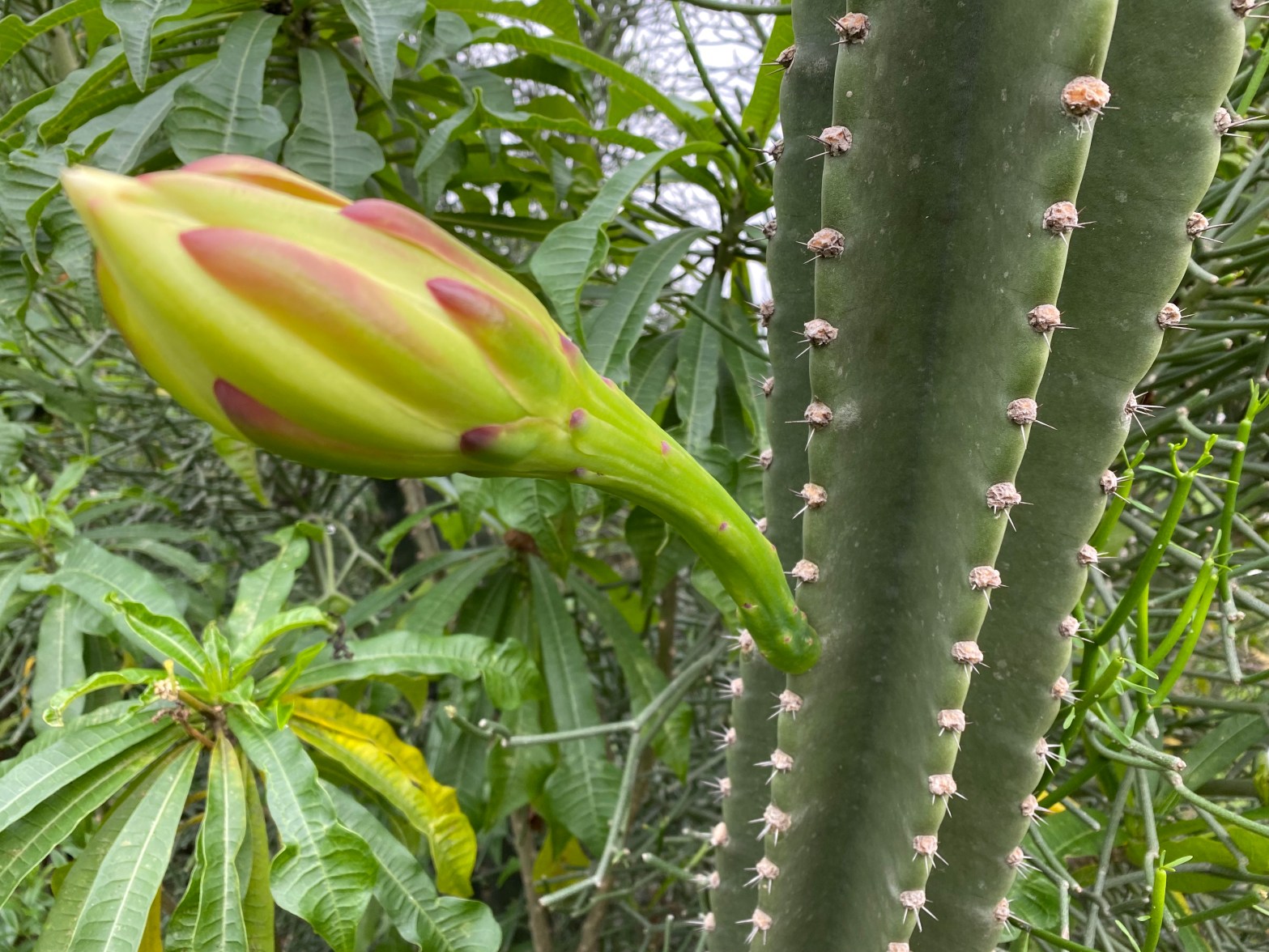
What has this to do with pines? Perhaps not much, although I imagine there are many ‘wastelands’ where pine trees could be part of the solution to maintain them more liveable for humans. With the risk of serving mainly as camouflage and scenery for those riding on the roads, of course. Here, in Accra, there should be no lack of trees to plant on streets and roads. The richness of the vegetation I encountered in the so called botanical garden, which felt like a rainforest, and even between the lawns on campus, created the feeling of living in a world of giant house plants. I think of the small Euphorbia in Stockholm that survived my neglect during Covid times and the huge Euphorbia (see image) that I encountered during one of our PAR-sessions…

 Pondering with Pines - Miettii Mäntyjen kanssa - Funderar med Furor